Thursday, 17 December 2015

Lighting


3 point lighting set up
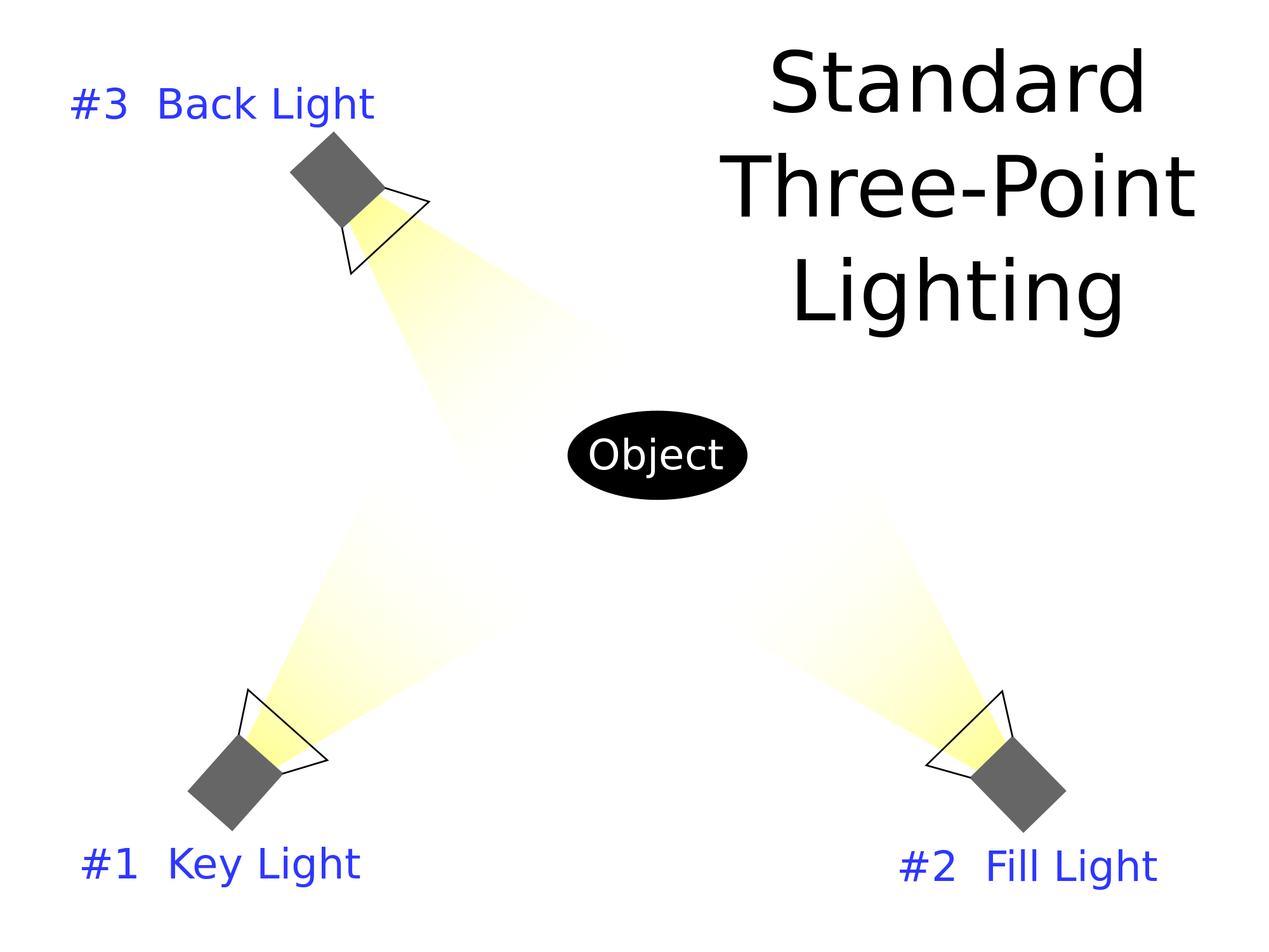

By setting up the sources of light like in this example, it allows you to focus all your direction of light on the subject in your shot. This also allows you to eliminate any shadows. In my set up, the key light was the specialized lamp, the fill light also being a lamp and for the back light I used an LED light mounted onto a tripod.

The key light, as the name suggests, shines directly upon the subject and serves as its principal illuminator; more than anything else, the strength, color and angle of the key determines the shot's overall lighting design.


Butterfly   

 Butterfly consists of a single light pointed directly at the subject straight on, and raised high enough to create a downward shadow on the subject. This causes a little ‘butterfly’ shadow to appear 
directly underneath the subject’s nose. 

Evaluation - Overall I am pleased with how this shot turned out. The 'butterfly' shadow that forms below the nose due to the positioning of the key light is much larger in some examples i have viewed although it is still visible.

Rembrandt

 Rembrandt lighting is a lighting technique that is used in studio portrait photography. It can be achieved using one light and a reflector, or two lights, and is popular because it is capable of producing images which appear both natural and compelling with a minimum of equipment. Rembrandt lighting is characterized by an illuminated triangle under the eye of the subject on the less illuminated side of the face

Evaluation - I struggled to get a perfect triangle using this lighting technique, this is definitely a technique for me to improve on. However I feel I understand the concept of the shot.


 High Key


High-key lighting is a style of lighting that aims to reduce the lighting ratio present in the scene. This was originally done partly for technological reasons, since early film and television did not deal well with high contrast ratios, but now is used to suggest an upbeat mood. High-key lighting is usually quite homogeneous and free from dark shadows. The terminology comes from the key light.


Low Key

Low-key lighting is a style of lighting for photography, film or television. It is a necessary element in creating a chiaroscuro effect. Traditional photographic lighting, three-point lighting uses a key light, a fill light, and a back light for illumination.


Reflector

Reflectors simply reflect the light from your light sources into the direction of the subject in your shot.


Evaluation - I did not notice too much of a difference whilst the subject was using the reflector, however I did have the lamps on quite high so there already was a lot of light directing to the subject.

Experimenting with shadows


The only light source I used in this shot, was an LED light positioned slight to the left of my camera, as you can see this developed angled shadow identical to the subject. It also has created a 'Horror' effect look within the shot due to the LED being the only source of light, therefore it is very low key.

Wednesday, 16 December 2015

My New Wave Evaluation

My New Wave video was heavily inspired by the opening scene from Godard's 'Breathless' (A Bout De Souffle). I was fascinated by how the lengthy shots all took place in the protagonist's car, and therefore I have replicated this in my own video. Alongside the editing used in the film I was intrigued by the unique style that Godard used in his feature.

In my own video I have tried to capture the protagonist in the car in multiple angles, something of which was not only common within Godard's Breathless, but also it is a feature that became a regular convention within the French New Wave. Arguably the most common convention, the jump cut, also appears within my film. The jump cut was used to break up parts of the narrative that would be used in typical Hollywood films, however in the French New Wave, these shots were not thought of as necessary. As the shots I have captured were filmed in a tight space, I decided to use jump cuts to provide the viewer with a larger variety of shots in an attempt to keep them engaged, and therefore throughout my video, the scenes will jump from one shot to another.

The audio in the French New Wave was diegetic in the majority of shots, again a convention I have tried to emulate. The difficulty I faced with this is when it came to editing my shots with one another, the audio captured was unclear due to the fact I was relying on the microphone built in the camera; Therefore next time I shoot I will improve the audio captured within my shots by using a more powerful recording device. Due to this I have included several non-diegetic audio pieces to accompany my shots, however I feel this takes away the realism, which is why of course that diegetic audio was used within the French New Wave. 

I have tried to put my own touch on the New Wave video by blending multiple shots into one another. Although this isn't a convention of the French New Wave, the directors of the New Wave often came up with new conventions, which is why the wave was so effective. I decided to build shots onto one another, lower the opacity and it created a unique visual experience. 

Lighting in the New Wave was the majority of time, natural. In my New Wave video the only artificial lighting used was the car light which was on when the car was not moving, so I decided to not use any extra sources of lighting. However because of this, some of my shots are maybe too dark as the whole sequence was shot at night. Although I am pleased with the effectiveness of some shots, for example, the traffic lights shot was almost blurred because it was shot in complete darkness and once I blended into other shots it looked quite appealing.

Editing

I made sure whilst I was editing my footage together I kept my workspace tidy with the use of labels and bins. This enabled me to access the files I needed with ease and therefore I didn't waste time searching for my footage. I also colour labelled the files based on how useful they were or whether they were in use or not. For example the rose colour means they were in use in my sequence at the time of editing.

Thursday, 10 December 2015

Laura Mulvey

The Gaze deals with how and audience views the people represented.

For feminists, the gaze can be thought of in three ways:

-How men view women
-How women view themselves
-How women look at other women

The theory of the 'Male Gaze' was formed in 1975 by Mulvey. Laura Mulvey believed that all audiences had to view the representation of characters through the perspective of a hetrosexual male.
Mulvey began to identify certain characteristics of the Male Gaze, techniques in the way films were shot such as cameras lingering on parts of a woman's body, which Mulvey believed relegated women to the status of objects.

 As a result, Mulvey believed that women were 'the bearer of meaning and not the maker of meaning.' Her statement suggests that women were not placed in a role that has control of a scene. Rather, they're something that's looked at in a scene and from a very specific point of view. Additionally, she also believed that this perspective was never reversed so that men were the ones being viewed. She argued that this inequality enforced the notion that,'men do the looking, and women are to be looked at.'

My example of the Male Gaze in film.

Project X...  https://www.youtube.com/watch?v=1jre6_FBBc0

In this video alone, young men are throwing girls into pools, using leaf blowers to blow girls skirts up, the camera is showing slowed down shots of girls licking each other. Project X is a prime example of the extreme lengths the male gaze can go too.

In this film, both visual signification and technical signification play a part in how the Male Gaze is presented to the viewer.

Visually, girls are seen throughout extremely sexualised, wearing limited, if any clothing. Shots of girls participating in sexual acts again are common.

Technically - The majority of the scenes mentioned above as slowed down, lengthening the time of the shot therefore relegating women to objects as Mulvey explained. Camera placement also plays a key part as in a few shots the camera has been placed to directly shoot up women's skirts.

In more recent years it has been discovered that 'The female gaze' is also apparent in certain films.
The Female Gaze is a Gaze trope about the way a work is presented as from a female perspective or reflects female attitudes, either because of the creator's gender or because it is deliberately aimed at a female audience. While it can contribute to it, Female Gaze is not restricted to looking at sexy men but is more importantly about the expectations of how the (presumptive) audience relates to the work.

Sigmund Freud


Sigmund Freud explored the human mind more thoroughly than any other who became before him.
His contributions to psychology are vast. Freud was one of the most influential people of the twentieth century and his enduring legacy has influenced not only psychology, but art, literature and even the way people bring up their children.

 Freud believed that dreams are the royal road to the unconscious and that they contained important clues into the human psyche. Much of his initial research methods involved questioning his patients on their dream experiences and using their descriptions as a means of uncovering their true motivations and perceptions on the world.

Film operates on much the same principle. Film speaks directly to the unconscious, the language of dreams is one that is not an abstract form of communication such as narrative, but it is one that is filled with images they carry hidden meanings on a latent level.

In 1923, Freud developed a more structural model of the mind comprising the entities id, ego and superego (what Freud called “the psychic apparatus”). These are not physical areas within the brain, but rather hypothetical conceptualizations of important mental functions.

A good example for explaining this research would be 'Fight Club', 1999, directed by David Fincher.

The ID - Unconscious desires, 'The repressed'. (Tyler Durden - Fight Club)


The id is the primitive and instinctive component of personality. It consists of all the inherited components of personality, including the sex instinct – Eros (which contains the libido), and the aggressive (death) instinct - Thanatos.
The id is the impulsive (and unconscious) part of our psyche which responds directly and immediately to the instincts. The personality of the newborn child is all id and only later does it develop an ego and super-ego.
The Ego - Conscious like a lifestyle. (The Narrator - Fight Club)
 Initially the ego is 'that part of the id which has been modified by the direct influence of the external world' (Freud 1923).

The ego develops in order to mediate between the unrealistic id and the external real world. It is the decision making component of personality. Ideally the ego works by reason, whereas the id is chaotic and totally unreasonable.
The Ego (The narrator) is the reality principle, always trying to meet the basic needs of the Id but also takes into account the real world. Therefore the right balance plays a key part for the ego (Tyler).

Superego - Based on morale principles, compromise. 
The superego incorporates the values and morals of society which are learned from one's parents and others. It develops around the age of 3 – 5 during the phallic stage of psychosexual development.
The superego's function is to control the id's impulses, especially those which society forbids, such as sex and aggression. It also has the function of persuading the ego to turn to moralistic goals rather than simply realistic ones and to strive for perfection.
The superego consists of two systems: The conscience and the ideal self. The conscience can punish the ego through causing feelings of guilt. For example, if the ego gives in to the id's demands, the superego may make the person feel bad through guilt.
The ideal self (or ego-ideal) is an imaginary picture of how you ought to be, and represents career aspirations, how to treat other people, and how to behave as a member of society.
Behavior which falls short of the ideal self may be punished by the superego through guilt. The super-ego can also reward us through the ideal self when we behave ‘properly’ by making us feel proud.


Wednesday, 2 December 2015

New Wave Video - Evaluation Draft 1

Construction of my video:


In order to keep my workspace and sequences organised I labeled all of my footage in terms of how useful the clips were. By doing this from the start it meant that I didn't have to waste time searching through all of my shots. 

1st Draft

For my 1st draft I created my opening scene. The narrative is extremely basic and is based in a car, an idea which I have replicated from Godard's Breathless. Jump cuts are heavily featured within my video, therefore I have chosen to skip the majority of narrative, something of which was common within the French New Wave. I have however decided to layer some of my videos as i wanted to try out different techniques. This is something very uncommon during the new wave, however I feel it accompanies the jump cuts in my video fairly well. 


Evaluation

Generally I am pleased so far with my video, however to improve it I feel that I need more footage to accompany it. The audio is extremely basic at the minute as I had to remove the audio off several clips for various reason and therefore my next aim is to gather more footage with useable diegetic audio. Also the majority of my shots I'm currently using are quite dark due to there being a lack of light sources. Therefore to improve this, when I shoot more footage I will film during the day or even use more sources of light to brighten my shots. The effect I am most pleased with is when I blend two or more shots together, it creates a really visual effect on the viewer; although this is a feature used more in contemporary films, I thought I would see how it looked with a French New Wave convention such as the jump cut.