Thursday, 17 December 2015

Lighting


3 point lighting set up
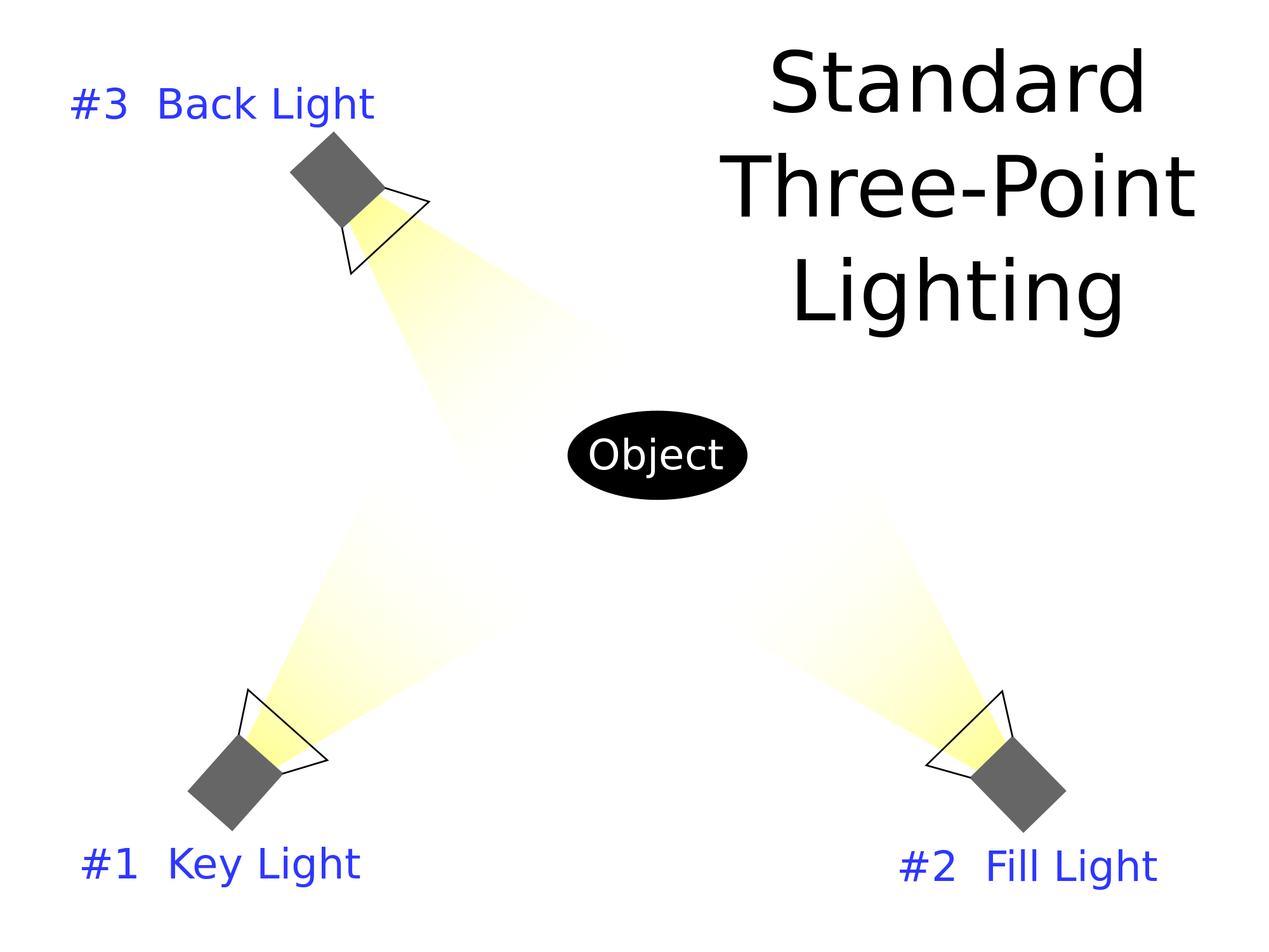

By setting up the sources of light like in this example, it allows you to focus all your direction of light on the subject in your shot. This also allows you to eliminate any shadows. In my set up, the key light was the specialized lamp, the fill light also being a lamp and for the back light I used an LED light mounted onto a tripod.

The key light, as the name suggests, shines directly upon the subject and serves as its principal illuminator; more than anything else, the strength, color and angle of the key determines the shot's overall lighting design.


Butterfly   

 Butterfly consists of a single light pointed directly at the subject straight on, and raised high enough to create a downward shadow on the subject. This causes a little ‘butterfly’ shadow to appear 
directly underneath the subject’s nose. 

Evaluation - Overall I am pleased with how this shot turned out. The 'butterfly' shadow that forms below the nose due to the positioning of the key light is much larger in some examples i have viewed although it is still visible.

Rembrandt

 Rembrandt lighting is a lighting technique that is used in studio portrait photography. It can be achieved using one light and a reflector, or two lights, and is popular because it is capable of producing images which appear both natural and compelling with a minimum of equipment. Rembrandt lighting is characterized by an illuminated triangle under the eye of the subject on the less illuminated side of the face

Evaluation - I struggled to get a perfect triangle using this lighting technique, this is definitely a technique for me to improve on. However I feel I understand the concept of the shot.


 High Key


High-key lighting is a style of lighting that aims to reduce the lighting ratio present in the scene. This was originally done partly for technological reasons, since early film and television did not deal well with high contrast ratios, but now is used to suggest an upbeat mood. High-key lighting is usually quite homogeneous and free from dark shadows. The terminology comes from the key light.


Low Key

Low-key lighting is a style of lighting for photography, film or television. It is a necessary element in creating a chiaroscuro effect. Traditional photographic lighting, three-point lighting uses a key light, a fill light, and a back light for illumination.


Reflector

Reflectors simply reflect the light from your light sources into the direction of the subject in your shot.


Evaluation - I did not notice too much of a difference whilst the subject was using the reflector, however I did have the lamps on quite high so there already was a lot of light directing to the subject.

Experimenting with shadows


The only light source I used in this shot, was an LED light positioned slight to the left of my camera, as you can see this developed angled shadow identical to the subject. It also has created a 'Horror' effect look within the shot due to the LED being the only source of light, therefore it is very low key.

Wednesday, 16 December 2015

My New Wave Evaluation

My New Wave video was heavily inspired by the opening scene from Godard's 'Breathless' (A Bout De Souffle). I was fascinated by how the lengthy shots all took place in the protagonist's car, and therefore I have replicated this in my own video. Alongside the editing used in the film I was intrigued by the unique style that Godard used in his feature.

In my own video I have tried to capture the protagonist in the car in multiple angles, something of which was not only common within Godard's Breathless, but also it is a feature that became a regular convention within the French New Wave. Arguably the most common convention, the jump cut, also appears within my film. The jump cut was used to break up parts of the narrative that would be used in typical Hollywood films, however in the French New Wave, these shots were not thought of as necessary. As the shots I have captured were filmed in a tight space, I decided to use jump cuts to provide the viewer with a larger variety of shots in an attempt to keep them engaged, and therefore throughout my video, the scenes will jump from one shot to another.

The audio in the French New Wave was diegetic in the majority of shots, again a convention I have tried to emulate. The difficulty I faced with this is when it came to editing my shots with one another, the audio captured was unclear due to the fact I was relying on the microphone built in the camera; Therefore next time I shoot I will improve the audio captured within my shots by using a more powerful recording device. Due to this I have included several non-diegetic audio pieces to accompany my shots, however I feel this takes away the realism, which is why of course that diegetic audio was used within the French New Wave. 

I have tried to put my own touch on the New Wave video by blending multiple shots into one another. Although this isn't a convention of the French New Wave, the directors of the New Wave often came up with new conventions, which is why the wave was so effective. I decided to build shots onto one another, lower the opacity and it created a unique visual experience. 

Lighting in the New Wave was the majority of time, natural. In my New Wave video the only artificial lighting used was the car light which was on when the car was not moving, so I decided to not use any extra sources of lighting. However because of this, some of my shots are maybe too dark as the whole sequence was shot at night. Although I am pleased with the effectiveness of some shots, for example, the traffic lights shot was almost blurred because it was shot in complete darkness and once I blended into other shots it looked quite appealing.

Editing

I made sure whilst I was editing my footage together I kept my workspace tidy with the use of labels and bins. This enabled me to access the files I needed with ease and therefore I didn't waste time searching for my footage. I also colour labelled the files based on how useful they were or whether they were in use or not. For example the rose colour means they were in use in my sequence at the time of editing.

Thursday, 10 December 2015

Laura Mulvey

The Gaze deals with how and audience views the people represented.

For feminists, the gaze can be thought of in three ways:

-How men view women
-How women view themselves
-How women look at other women

The theory of the 'Male Gaze' was formed in 1975 by Mulvey. Laura Mulvey believed that all audiences had to view the representation of characters through the perspective of a hetrosexual male.
Mulvey began to identify certain characteristics of the Male Gaze, techniques in the way films were shot such as cameras lingering on parts of a woman's body, which Mulvey believed relegated women to the status of objects.

 As a result, Mulvey believed that women were 'the bearer of meaning and not the maker of meaning.' Her statement suggests that women were not placed in a role that has control of a scene. Rather, they're something that's looked at in a scene and from a very specific point of view. Additionally, she also believed that this perspective was never reversed so that men were the ones being viewed. She argued that this inequality enforced the notion that,'men do the looking, and women are to be looked at.'

My example of the Male Gaze in film.

Project X...  https://www.youtube.com/watch?v=1jre6_FBBc0

In this video alone, young men are throwing girls into pools, using leaf blowers to blow girls skirts up, the camera is showing slowed down shots of girls licking each other. Project X is a prime example of the extreme lengths the male gaze can go too.

In this film, both visual signification and technical signification play a part in how the Male Gaze is presented to the viewer.

Visually, girls are seen throughout extremely sexualised, wearing limited, if any clothing. Shots of girls participating in sexual acts again are common.

Technically - The majority of the scenes mentioned above as slowed down, lengthening the time of the shot therefore relegating women to objects as Mulvey explained. Camera placement also plays a key part as in a few shots the camera has been placed to directly shoot up women's skirts.

In more recent years it has been discovered that 'The female gaze' is also apparent in certain films.
The Female Gaze is a Gaze trope about the way a work is presented as from a female perspective or reflects female attitudes, either because of the creator's gender or because it is deliberately aimed at a female audience. While it can contribute to it, Female Gaze is not restricted to looking at sexy men but is more importantly about the expectations of how the (presumptive) audience relates to the work.

Sigmund Freud


Sigmund Freud explored the human mind more thoroughly than any other who became before him.
His contributions to psychology are vast. Freud was one of the most influential people of the twentieth century and his enduring legacy has influenced not only psychology, but art, literature and even the way people bring up their children.

 Freud believed that dreams are the royal road to the unconscious and that they contained important clues into the human psyche. Much of his initial research methods involved questioning his patients on their dream experiences and using their descriptions as a means of uncovering their true motivations and perceptions on the world.

Film operates on much the same principle. Film speaks directly to the unconscious, the language of dreams is one that is not an abstract form of communication such as narrative, but it is one that is filled with images they carry hidden meanings on a latent level.

In 1923, Freud developed a more structural model of the mind comprising the entities id, ego and superego (what Freud called “the psychic apparatus”). These are not physical areas within the brain, but rather hypothetical conceptualizations of important mental functions.

A good example for explaining this research would be 'Fight Club', 1999, directed by David Fincher.

The ID - Unconscious desires, 'The repressed'. (Tyler Durden - Fight Club)


The id is the primitive and instinctive component of personality. It consists of all the inherited components of personality, including the sex instinct – Eros (which contains the libido), and the aggressive (death) instinct - Thanatos.
The id is the impulsive (and unconscious) part of our psyche which responds directly and immediately to the instincts. The personality of the newborn child is all id and only later does it develop an ego and super-ego.
The Ego - Conscious like a lifestyle. (The Narrator - Fight Club)
 Initially the ego is 'that part of the id which has been modified by the direct influence of the external world' (Freud 1923).

The ego develops in order to mediate between the unrealistic id and the external real world. It is the decision making component of personality. Ideally the ego works by reason, whereas the id is chaotic and totally unreasonable.
The Ego (The narrator) is the reality principle, always trying to meet the basic needs of the Id but also takes into account the real world. Therefore the right balance plays a key part for the ego (Tyler).

Superego - Based on morale principles, compromise. 
The superego incorporates the values and morals of society which are learned from one's parents and others. It develops around the age of 3 – 5 during the phallic stage of psychosexual development.
The superego's function is to control the id's impulses, especially those which society forbids, such as sex and aggression. It also has the function of persuading the ego to turn to moralistic goals rather than simply realistic ones and to strive for perfection.
The superego consists of two systems: The conscience and the ideal self. The conscience can punish the ego through causing feelings of guilt. For example, if the ego gives in to the id's demands, the superego may make the person feel bad through guilt.
The ideal self (or ego-ideal) is an imaginary picture of how you ought to be, and represents career aspirations, how to treat other people, and how to behave as a member of society.
Behavior which falls short of the ideal self may be punished by the superego through guilt. The super-ego can also reward us through the ideal self when we behave ‘properly’ by making us feel proud.


Wednesday, 2 December 2015

New Wave Video - Evaluation Draft 1

Construction of my video:


In order to keep my workspace and sequences organised I labeled all of my footage in terms of how useful the clips were. By doing this from the start it meant that I didn't have to waste time searching through all of my shots. 

1st Draft

For my 1st draft I created my opening scene. The narrative is extremely basic and is based in a car, an idea which I have replicated from Godard's Breathless. Jump cuts are heavily featured within my video, therefore I have chosen to skip the majority of narrative, something of which was common within the French New Wave. I have however decided to layer some of my videos as i wanted to try out different techniques. This is something very uncommon during the new wave, however I feel it accompanies the jump cuts in my video fairly well. 


Evaluation

Generally I am pleased so far with my video, however to improve it I feel that I need more footage to accompany it. The audio is extremely basic at the minute as I had to remove the audio off several clips for various reason and therefore my next aim is to gather more footage with useable diegetic audio. Also the majority of my shots I'm currently using are quite dark due to there being a lack of light sources. Therefore to improve this, when I shoot more footage I will film during the day or even use more sources of light to brighten my shots. The effect I am most pleased with is when I blend two or more shots together, it creates a really visual effect on the viewer; although this is a feature used more in contemporary films, I thought I would see how it looked with a French New Wave convention such as the jump cut. 


Monday, 30 November 2015

Laura Mulvey - Male Gaze

The male gaze is a concept coined by feminist film critic Laura Mulvey. It refers to the way visual arts are structured around a masculine viewer. It describes the tendency in visual culture to depict the world and women from a masculine point of view and in terms of men's attitudes.
The male gaze consists of three different gazes:
  • that of the person behind the camera,
  • that of the characters within the representation or film itself, and
  • that of the spectator.

The concept was first developed by feminist film critic Laura Mulvey in her 1975 essay entitled "Visual Pleasure and Narrative Cinema". Mulvey posits that the gender power asymmetry is a controlling force in cinema and constructed for the pleasure of the male viewer, which is deeply rooted in patriarchal ideologies and discourses. The concept has subsequently been prominent in feminist film theorymedia studies, as well as communications and cultural studies.

The male gaze occurs when the camera puts the audience into the perspective of a heterosexual man. It may linger over the curves of a woman's body, for instance. The woman is usually displayed on two different levels: as an erotic object for both the characters within the film and for the spectator who is watching the film. The man emerges as the dominant power within the created film fantasy. The woman is passive to the active gaze from the man. This adds an element of "patriarchal" order, and it is often seen in "illusionistic narrative film". Mulvey argues that, in mainstream cinema, the male gaze typically takes precedence over the female gaze, reflecting an underlying power asymmetry.

Mulvey' also states that the female gaze is the same as the male gaze because women look at themselves through the eyes of men. A feminist may see the male gaze as either a manifestation of unequal power between gazer and gazed, or as a conscious or subconscious attempt to develop that inequality. From this perspective, a woman who welcomes an objectifying gaze may be simply seeking to benefit men, welcoming such objectification may be viewed as akin to exhibitionism.

The Male Gaze typically focuses on:

-         Emphasising curves of the female body
-         Referring to women as objects rather than people
-         The display of women is how men think they should be perceived
-         Female viewers, view the content through the eyes of 
     a man


The Clip above is from 'Project X', which contains large amounts of sexualised images of Women.

Thursday, 19 November 2015

Development Of Editing Techniques

Although the earliest films in cinema were done in one shot without any editing, cutting is so fundamental to the medium that it began to emerge relatively quickly. There was a basic disparity between the amount of film that a camera's magazine could hold and the evolving desire of filmmakers and audiences for longer and more elaborate story films. Only by editing shots together could longer narrative forms be achieved. A Trip to the Moon (1914), directed by Georges Méliès creates a narrative by assembling a series of scenes, with each scene filmed in a single shot. The edit points occur between the scenes, in order to link them together.

The 1903 film ‘The Great Train Robbery’, is one of the most iconic films of the early film years, simply because it was one of the first films to use more than one scene. This was the first narrative film that audiences could see going somewhere and was very successful amongst different audiences. It is not clear that he means for the parallel editing to establish that two lines of action are in fact happening simultaneously. In other respects, editing in The Great Train Robbery remains very primitive, with cuts used only to join scenes and with no intercutting inside a scene.

The film ‘Life of an American Fireman’ includes one of the most famous uses of crosscutting, and was a massive step in editing history. Edwin S. Porter, the Editor, was celebrated for his unusual but exciting style of editing. He wanted his audiences to feel worried for people in the film who were stuck in a burning house, unsure of whether the fireman would be able to rescue them; he wanted to build up tension in his audience, and did this by the use of crosscutting. Similar to Sergei Eisenstein, Porter used editing to try and get an emotional response from his audience.


Porter’s techniques were very different from those of D. W. Griffith. A man names Cecil Hepworth wanted to try and bridge the gap between the two styles of editing, and bring all the different styles together. He created a film known as ‘Rescued by Rover’ in 1905 and was a British silent film (A film with no voices). The film was the most advanced film seen at the time, due to its use of fantastic storytelling, production and editing.


In contrast with Porter, D. W. Griffith freed the camera from the conventions of stage perspective by breaking the action of scenes into many different shots and editing these according to the emotional and narrative rhythms of the action. 
Cutting from full-figure shots to a close-up accentuated the drama, and matching the action on a cut as a character walks from an exterior into a doorway and, in the next shot, enters an interior set enabled Griffith to join filming locations that were physically separated but adjacent in terms of the time and place of the story.

Griffith became famous for his use of crosscutting. In The Girl and Her Trust (1912), for example, Griffith cuts back and forth from a pair of robbers, who have abducted the heroine and are escaping on a railroad pump car, to the hero, who is attempting to overtake them by train. By intercutting these lines of action, Griffith creates suspense, and by shortening the lengths of the shots, he accelerates the pace. Crosscutting furnished a foundation for narrative in cinema, and there is little structural difference between what Griffith did here and what a later filmmaker such as Steven Spielberg does in Jaws (1975). 


Griffith extended his fluid use of continuity editing and crosscutting in his epics The Birth of a Nation (1915) and Intolerance (1916). The latter film is a supreme example of crosscutting, which is here used to tell four stories set in different time periods in simultaneous fashion.


Sergei Eisenstein is a wholly unique figure in cinema history. He was a filmmaker and a theoretician of cinema who made films and wrote voluminously about their structure and the nature of cinema. Both his filmmaking and his writing (which fills several volumes) have been tremendously influential.

Frustrated by the creative limitations of his work in the theater, Eisenstein turned to cinema and in 1925 completed his first feature, Stachka Strike ), which depicted the plight of oppressed workers. Eisenstein's next two films are the ones by which he remains best known, Bronenosets Potyomkin Battleship Potemkin , 1925) and Oktyabr (Ten Days That Shook the World and October , 1927), each depicting political rebellion against czarist rule.
Eisenstein believed that editing was the foundation of film art. For Eisenstein, meaning in cinema lay not in the individual shot but only in the relationships among shots established by editing. Translating a Marxist political perspective into the language of cinema, Eisenstein referred to his editing as "dialectical montage" because it aimed to expose the essential contradictions of existence and the political order. Because conflict was essential to the political praxis of Marxism, the idea of conflict furnished the logic of Eisenstein's shot changes, which gives his silent films a rough, jagged quality. His shots do not combine smoothly, as in the continuity editing of D. W. Griffith and Hollywood cinema, but clash and bang together. Thus, his montages were eminently suited to depictions of violence, as in Strike Potemkin , and Ten Days . In his essays Eisenstein enumerated the numerous types of conflict that he found essential to cinema. These included conflicts among graphic elements in a composition and between shots, and conflict of time and space created in the editing process and by filming with different camera speeds.


Film Editing Techniques

Before the widespread use of non-linear editing systems, the initial editing of all films was done with a positive copy of the film negative called a film workprint by physically cutting and pasting together pieces of film. Strips of footage would be hand cut and attached together with tape and then later in time, glue. Editors were very precise; if they made a wrong cut or needed a fresh positive print, it cost them money for the lab to reprint the footage and push the editing process back farther. 

With the invention of a splicer and threading machine with a viewer such as a Moviola, or "flatbed" machine such as a K.-E.-M. or Steenbeck, the editing process sped up a little bit and cut came out cleaner and more precise.
MoviolaMoviola is a device that allows a film editor to view film while editing. It was the first machine for motion picture editing when it was invented by Iwan Serrurier in 1924. 

Flat bedPicture and sound rolls load onto separate motorized disks, called "plates." Each set of plates moves forward or backward separately, or locked together to maintain synchronization between picture and sound.


But the past 20 or so years has also seen the rise of "digital editing", which makes any kind of editing easier. The notion of editing film on video originated when films were transferred to video for television viewing. Then filmmakers used video to edit their work more quickly and less expensively than they could on film. The task of cleanly splicing together video clips was then taken over by computers using advanced graphics programs that could then also perform various special effects functions. Finally, computers convert digital images back into film or video. These digital cuts are a very far cry from Méliè's editing in the camera.

Most films are edited digitally (on systems such as AvidFinal Cut Pro or Premiere Pro) and bypass the film positive workprint altogether. In the past, the use of a film positive allowed the editor to do as much experimenting as he or she wished, without the risk of damaging the original. With digital editing, editors can experiment just as much as before except with the footage completely transferred to a computer hard drive; losing the original footage is an only one computer crash away.


Scene Analysis - Breathless


This is an example of me labelling my work, ensuring my workspace is tidy and organised. It also allows me to keep my useful text and footage apart meaning I am not spending too much time sorting through material.

4 Hour Film Challenge - The Conversation

https://www.youtube.com/watch?v=GO6qM4I8kxo

The 4 hour film challenge

This film challenge was incredibly harder than I imagined. As we had to create a short film based around the title, 'The Conversation', we decided to play to our strengths and we made a short film involving a montage.

Film Synopsis

A young boxer has the most important fight of his life coming up. With no family, his only companion is his close personal friend/trainer, who inspires him to work hard and train hard after 'the conversation'.

I was responsible for filming this short film, we wanted to shoot as much footage as we could in this short amount of time. We decided to use two Canon DSLR and a GoPro Hero 4 for the filming. The DSLR allowed us to shoot good quality shots, whilst the GoPro gave us unique angles and made the film almost interactive for the viewer as it felt like they were in the eyes of the character.

                          
For the audio, as the DSLR doesn't have the best of microphones within it, we decided to use a slide on zoom mic which is attached on the top of the camera. In certain shots the characters are holding the microphone in order to increase the sound quality further. I was then responsible for editing the sound together with the footage.


Overall I am extremely pleased with how this video has turned out. We wanted the montage sequence to look like an actual 'Rocky' themed montage, so to do this, we spent time slowing down certain 'Rocky' montages and viewing the shots that were used to make it look so effective.  The onstage need to cut from scene to scene extremely sharp, a variety of angles needed to be used and most importantly tense music was needed! I edited the video so that each scene cut extremely quick and sharp to another shot, with the two Canon DSLRs and the GoPro we were able to capture a number of angles and when we combined this with the montage music, we were extremely pleased.

As we wanted the montage to be a decent length, we came across the problem of getting long lengths of footage in a short length of time. For certain shots of the montage we decided to speed up the footage to make it seem as though his training his starting to become beneficial, so therefore this didn't turned out quite effective.

Contextual Studies Video Essay

https://www.youtube.com/watch?v=3ENWOb8bZ3A

 
Bibliography


http://www.filmeducation.org/pdf/resources/secondary/FrenchNouvelleVague.pdf

http://www.newwavefilm.com/new-wave-cinema-guide/nouvelle-vague-where-to-start.shtml

http://www.newwavefilm.com/french-new-wave-encyclopedia/francois-truffaut.shtml

http://www.newwavefilm.com/french-new-wave-encyclopedia/jean-luc-godard.shtml

http://www.newwavefilm.com/french-new-wave-encyclopedia/claude-chabrol.shtml

http://www.newwavefilm.com/french-new-wave-encyclopedia/jacques-rivette.shtml

http://theculturetrip.com/europe/france/articles/the-french-new-wave-revolutionising-cinema/

http://www.theblackandblue.com/2010/03/29/the-french-new-wave-a-cinematic-revolution/

https://www.youtube.com/watch?v=hii6sZBoBXs

https://www.youtube.com/watch?v=XJbPHboAsbQ

Evaluation

To produce my French New Wave essay I had to do large amounts of research on why it had such an effect on cinema. I started by researching the key individuals who went from writing reviews for the film magazine 'Cahiers Du Cinema'. Godard, Truffaut, Chabrol and Rivette all shared a vital role in the New Wave as they decided to go from writing about films, to directing them. I then watched a few of the most famous texts from the New Wave. This included the likes of Godard's 'Breathless' (A Bout De Souffle) and Truffaut's 400 Blows (Les 400 Coups).

For my video essay I decided to really go into depth with how the French New Wave started in a country that was seriously lacking real entertainment. Therefore the first half of my essay solely focuses on France during the start of the New Wave and how the individuals who were part of it, went on to make a large impact in later cinema. I have tried to find footage and pictures of France during the 1950's and 60's whilst the voiceover describes life during those times, to show how cinema was a vital part of culture damaged, post-war France. Once I felt that I had gone into detail on the culture at the time, I began to one by one, explain how each of the Cahiers critics went from writing about films to actually making them. To do this I had to find lots of images of the likes of Truffaut, Godard, Chabrol and Rivette whilst they were making these New Wave films. I was able to find useful footage of each of them participating in interviews. I then placed the focus of the essay on Godard's 'Breathless' and Truffaut's '400 Blows' as I began to go into detail about the changes that the New Wave brought to cinema. Along with the voiceover explaining the commonly used features during the New Wave, I used examples of footage and stills from both of the films so the viewer of my essay can visually recognise the conventions that the French New Wave consisted of. I then finished off my essay by explaining the effect that the French New Wave has had on today's cinema. For example, as Quentin Tarantino is inspired by the New Wave and specifically Godard, it is said that 'Pulp Fiction' is inspired by 'Breathless', so therefore accompanying my voiceover are clips from films such as Pulp Fiction.

French New Wave - Video Plan & Design Brief

Location

I will shoot my French New Wave video at Liberty Way, Nuneaton. Featuring a Football Ground and surrounding industrial estates it will make a unique setting for my French New Wave video


When

Week commencing 23/11/15
                                                                                                                                       
How

I want my New Wave film to have a unclear narrative, with multiple shots intertwining with one another. I intend to use a large variety of angles, some of which I will take from the French New Wave genre and experiment with. The majority of my camera shots will be inspired by the French New Wave, especially jump cuts which I intend to base my film around; I want the shots to jump sharply to one another. This shot in 'Vivre Sa Vie' is a shot/reverse shot. I'm planning on using this type of shot to introduce my characters.    


I also want to experiment by breaking the 180 degree rule and seeing the effect I can create for the viewer. The 180 degree rule is used to restrict confusion for the viewer, by breaking it, the footage all of a sudden becomes unclear and loses it's sense of direction, making it difficult for the viewer to fully understand; an example of this can be viewed in 'The Shining'


Kit Required 


x 1 Digital SLR

x 1 Tripod
x 1 Standard lens
x 1 2.8mm lens 

Health and Safety / Risk Assessment 

Despite the estate being quiet around the time I plan on filming, recording on the road will always be a risk so we have to ensure that we record in safe places only. When shooting with tripods we will have to make ensure they will not fall over and break anything or hurt anybody. As well as this is important for us to ensure we were not in anybodies personal work space or private property.

Brief

My New Wave film will have an unclear narrative, it will contain a variety of different length shots of which some will connect to each other, others will be purposely out of place. All of my footage will contain natural lighting and diegetic sounds, when shooting outside I will deliberately try to capture the sound of the wind to enhance the realism of my film. I may over certain shots use a non-diegetic track however my plan at the moment is to use music in a diegetic way when recording, again to try and enhance the naturalism of my shot. Large parts of my video will be shot inside a car and I am going to shoot like this as I was inspired by Godard's Breathless in which the opening scene is in the protagonist's car.

Wednesday, 4 November 2015

Health and Safety

Health & Safety 


Despite the majority of filming taking place on the college site, there are various subjects that mean extra safety precautions must be made:

* When filming in a general classroom environment we must make sure that there weren't any wires that people could trip over

* Also when shooting with tripods we will have to make ensure they will not fall over and break anything or hurt anybody. As well as this it was important for us to ensure we were not in anybodies personal/work space

* In the photography studio, we must ensure all wires are taped to the floor to make sure no one trips or damages the lighting equipment. When the studio lights are not in use they must be switched off at the wall and left to cool before being handles as the bulbs become very hot and could burn someone or break when moved.

Thursday, 22 October 2015

Shutter Speed


This first example was shot at 30 Shutter Speed, F.8 and ISO 400. Due to the shutter speed being set quite low, the motion is not very smooth.


However this example has been shot with the Shutter Speed at 100, F.8 and ISO 800. The motion is much smoother and there is no blur. Although due to the Shutter Speed being set higher I had to raise the ISO and this slightly decreased the quality of the shot.


 How effective were your videos?

The shots I took show the difference in shutter speed, and therefore the difference in the motion and how smooth the videos are. 

What were your strengths? 

I was able to shoot two shots which enabled me to view the difference in shutter speed 1/30 and 1/100. This therefore enabled me to highlight how motion and smoothness is affected as I changed the shutter speed. 

What were your areas of weakness?

To further emphasise the difference in shutter speed, i feel like I should've shot a faster moving image, perhaps a car would definitely have shown has a low shutter speed can produce lots of motion blur, compared to a high shutter speed which stops the motion blur and produces a much smoother shot.

 Recommendations 

Next time I would re-shoot but this time the subject in my shot which be something faster so that I could capture more motion blur at a low shutter speed and then show how raising the shutter speed produces a smoother image. 

Friday, 16 October 2015

Tirez Sur De La Pianiste - Truffaut

Plot

A washed-up classical pianist, Charlie Kohler/Edouard Saroyan (Charles Aznavour), bottoms out after his wife's suicide — stroking the keys in a Parisian dive bar. The waitress, Lena (Marie Dubois), is falling in love with Charlie, who it turns out is not who he says he is. When his brothers get in trouble with gangsters, Charlie inadvertently gets dragged into the chaos and is forced to rejoin the family he once fled.

Truffaut

While maintaining the dark and dramatic atmosphere of the book, Truffaut plays free and loose with genre conventions, consistently undermining our expectations and abruptly changing pace and tone without warning. In the opening sequence we see Chico running for his life through the city streets at night. Shots flash by in a rapid blur in near darkness or the glare of harsh street lighting. Then, abruptly the mood changes, a passer-by helps the dazed Chico to his feet. A long continuous tracking shot follows as they walk along the street discussing the benefits of love and marriage. This playful approach continues through the rest of the picture. The iconography of the musical, western, romance and melodrama genres feature briefly, interrupting the conventional crime story narrative. Abundant comic touches in particular distinguish the film from its source material and other films of the same genre. The hoodlums are portrayed more like the Marx brothers than real tough guys, endlessly discussing and arguing about subjects such as women’s secret desires. In one famous scene one of the gangsters proclaims “May my mother drop dead if I tell a lie” which is immediately followed by a shot of an old woman clutching her heart and collapsing.

The film's script changed constantly during shooting. Truffaut said that "In Shoot the Piano Player I wanted to break with the linear narrative and make a film where all the scenes would please me. I shot without any criteria." Truffaut's stylized and self-reflexive melodrama employs the hallmarks of French New Wave cinema: extended voice-overs, out-of-sequence shots, and sudden jump cuts. The film's cinematography by Raoul Coutard was often grainy and kinetic, reflecting the emotional state of the characters, such as the scene in which Charlie hesitates before ringing a doorbell.

French New Wave

Using light-weight portable equipment, hand-held cameras and requiring little or no set up time, the New Wave way of film-making presented a documentary style. The films exhibited direct sounds on film stock that required less light. Filming techniques included fragmented, freeze-frames, discontinuous editing, and long takes. The combination of objective realism, subjective realism, and authorial commentary created a narrative ambiguity in the sense that questions that arise in a film are not answered in the end.

http://www.newwavefilm.com/french-new-wave-encyclopedia/shoot-the-piano-player.shtml
http://www.classicartfilms.com/shoot-the-piano-player-1960
https://en.wikipedia.org/wiki/Shoot_the_Piano_Player

Vivre Sa Vie - Godard

Plot 

Nana (Anna Karina), a beautiful Parisian in her early twenties, leaves her husband and infant son hoping to become an actress. Without money, beyond what she earns as a shopgirl, and unable to enter acting, she elects to earn better money as a prostitute. Soon she has a pimp, Raoul, who after an unspecified period agrees to sell Nana to another pimp. During the exchange the pimps argue and in a gun battle Nana is killed. Nana's short life on film is told in 12 brief episodes each preceded by a written resume. Godard introduces other idiosyncrasies to focus the viewer's attention.

Godard 

Raoul Coutard, the cinematographer who worked side-by-side with Godard during this period, has his camera track back and forth, first behind Nana's head, then Paul's, their faces glimpsed in the mirror. "The film was made by sort of a second presence," Godard said; the camera is not just a recording device but a looking device, that by its movements makes us aware that it sees her, wonders about her, glances first here and then there, exploring the space she occupies, speculating.

One of Vivre Sa Vie's major themes that Godard seems to explore is the subject of verbal and non-verbal communication between people within real life and also within the cinema. In one of the greatest sequences in the film the character of Nana spends the last money she has on the viewing of Carl Dreyer's silent masterpiece The Passion of Joan of Arc. The audience witnesses Nana weep as she identifies with Joan, the teary eyed martyr on the movie screen, as Godard brilliantly captures and iconized the tragic art of the cinema, in a heartbreaking sequence without the use of words.


http://www.classicartfilms.com/vivre-sa-vie-1962
http://www.rogerebert.com/reviews/great-movie-vivre-sa-vie--my-life-to-live-1963

Aperture F2.8, F.8, F.16


This example was shot in Aperture F2.8, 1/80 Shutter Speed an ISO 800. Due to the F2.8 shot which was captured on a 50mm lens, has an extremely shallow depth of field; This means the object in close proximity to the camera will be in focus, anything past that object will be out of focus.

This example was shot in Aperture f.8, 1/160 SS, 1600 ISO. As you can tell, compare to the last example, the depth of field has been extended, however parts of the background are still out of focus.


This example was shot in Aperture f.16, 80ss, 1600 ISO. This example allows large amounts of the shot to be in focus due to the deep depth of field and narrow opening. 

 How effective were your videos?

My shots allowed me to view the difference in aperture, and therefore I learnt about difference in focus and the range and also how it affects the lighting.What were your strengths? Why?

What were your areas of weakness? Why?

Unfortunately I didn't use a tripod so my shot is sometimes unsteady, a tripod could have made a difference to my shot. 

 Recommendations

I would improve my videos next time by shooting all the shots in the same setting, therefore you could see the gradual change in focus as the aperture changes. 

A Bout De Souffle - Godard

Plot

Michel (Jean-Paul Belmondo) is a youthful criminal who is intrigued with the film persona of Humphrey Bogart. After stealing a car in Marseille, Michel shoots and kills a policeman who has followed him onto a country road. Penniless and on the run from the police, he turns to an American love interest Patricia (Jean Seberg), a student and aspiring journalist, who sells the New York Herald Tribune on the streets of Paris. The ambivalent Patricia unwittingly hides him in her apartment as he simultaneously tries to seduce her and call in a loan to fund their escape to Italy. At one point, Patricia says she is pregnant with Michel's child. She learns that Michel is on the run when questioned by the police. Eventually she betrays him, but before the police arrive she tells Michel what she has done. He is somewhat resigned to a life in prison, and does not try to escape at first. The police shoot him in the street and, after a prolonged death run, he dies “à bout de souffle” (out of breath).
Godard 
Filming took place over the summer of 1959. Behind the camera was Raoul Coutard, originally a documentary cameraman for the French army’s information service in Indochina during the war. Coutard’s background suited Godard who wanted the film to be shot, as much as possible, like a documentary, with a handheld camera and the minimum of lighting. This decision was taken for both aesthetic reasons – making the film look like a newsreel – and practical reasons – saving the time setting up lights and tripod.
Flexibility was very important to Godard, who wanted the freedom to improvise and shoot whenever and wherever he wanted without too many technical constraints. He and Coutard devised ways – such as using a wheelchair for tracking shots and shooting with specialist lowlight filmstock for nighttime scenes – to make this possible.
Godard’s unorthodox methods continued in the editing suite. His first cut of À bout de souffle was two-and-a-half hours long but Beauregard had required he deliver a ninety-minute film. Rather than cutting out whole scenes, he decided to cut within scenes, even within shots. This use of deliberate jump cuts was unheard of in professional filmmaking where edits were designed to be as seamless as possible. He also cut between shots from intentionally disorienting angles that broke all the traditional rules of continuity. By deliberately appearing amateurish Godard drew attention to the conventions of classic cinema, revealing them for what they were, merely conventions.